Wednesday, May 20, 2009

A little about the next 8 weeks of my life

A little less than a year later, I'm back and have an event in my life that others (likely mostly family) might be interested in hearing about. I've been presented the opportunity to do an unpaid internship in Guatemala by the Whole Planet Foundation, the microcredit organization/partner of Whole Foods. My mom gave wheels to the then unknown opportunity by introducing me to Mr. Philip Sansone, the Executive Director of Whole Planet Foundation and a Texas Tech graduate. I met with Philip for the first time earlier this semester to discuss his experiences in Peace Corps as well as to talk to him about microcredit lending, a subject I've been pretty fascinated with for the better part of my college career. I met with Philip and another man, Evan, who has a more recent experience with Peace Corps at the coffee shop in the Whole Foods in downtown Austin, also the location of Whole Food and Whole Planet's corporate offices. We talked for a bit and Philip said he might have a potential internship opportunity in Guatemala that could utilize my Spanish abilities as well as provide me an opportunity to experience microcredit lending first hand. Naturally it was something I jumped at; the only downfall being that I would have to cover all my costs. I talked to the parents and they backed me fully, and things began to roll into motion. Here I am now, I leave in 5 days and I'm not quite sure the magnitude of what's ahead has fully set in, but I don't think I've ever been too talented in feeling prepared for the task at hand—that's not to say I'm not prepared, I just have a hard time convincing myself mentally.


This first update will serve as an introduction and informational about microcredit, Whole Planet, Grameen Bank and where I'll be in Guatemala as well as a small segment about the current political situation in Guatemala.

What is microcredit?


I'm going to copy and paste bits and pieces of a couple of papers I wrote for my Economics classes at Southwestern that sum up microcredit. Apologies for the dryness of the writing…


The Microcredit Summit Campaign defines microcredit as "Programs extending small loans, and other financial services such as savings, to very poor people for self-employment projects that generate income, allowing them to care for themselves and their families." (Microcredit Summit Campaign Online) These loans are typically made without attached collateral and are given to those who otherwise might not be eligible to receive a loan, specifically those of the most impoverished classes. Loans to the extremely poor are often seen as extremely risky; a risk many have been afraid to take (Robinson 2001, pg.20).


One of the most prominent microfinance institutions is the Grameen Bank founded by Nobel laureate Muhammad Yunus. Yunus constructed a lending system devised to help the rural poor invest in their own businesses and encourage entrepreneurialism so as to alleviate poverty in those areas. The regulated bank started with a small loan to a group of women and has grown to lend money to "7.58 million borrowers, 97 percent of whom are women. With 2,530 branches, [Grameen Bank] provides services in 83,178 villages, covering more than 99 percent of the total villages in Bangladesh" (Grameen Bank Online, 2008). The Grameen Bank takes the stance that borrowers are responsible and does not educate their borrowers like some Microfinance Instituions (Brigham Young University Broadcasting 2005). The growth and success of the Grameen bank has inspired the construction of similar programs around the world.

Grameen Bank has been one of the most successful microcredit institutions and has even expanded its operations in Bangladesh to provide telecommunications services and, more recently, healthcare to its borrowers. As a means of alleviating poverty, microfinance is a very positive movement, though not a perfect one. Many microfinance institutions are not profitable and must rely on donor money to stay afloat. The obvious bias towards women has been criticized for putting too much pressure on women, especially in chauvinistic societies, but the proof that women repay their loans at a much higher rate than men is hard to ignore. The microfinance institution that I will be interning with in Guatemala is a branch of Grameen Bank and is a partnership between said bank and the Whole Planet Foundation.

Whole Planet Foundation


From Whole Planet's website, stating their mission:

"The Whole Planet Foundation's mission is to create economic partnerships with the poor in those developing-world communities that supply our stores with product. Through innovative assistance for entrepreneurship - including direct microcredit loans and tangible support for other community partnership projects - we seek to unleash the energy and creativity of every human being we work with in order to create wealth and prosperity in emerging economies."


Whole Planet foundation began in 2005 and issues grants through money raised by the company to microfinance institutions around the world, one such program being the one in Panajachel, Guatemala, where I'll be working.


For more information and opportunities to donate to this cause, visit Whole Planet's website.


Panajachel, Guatemala
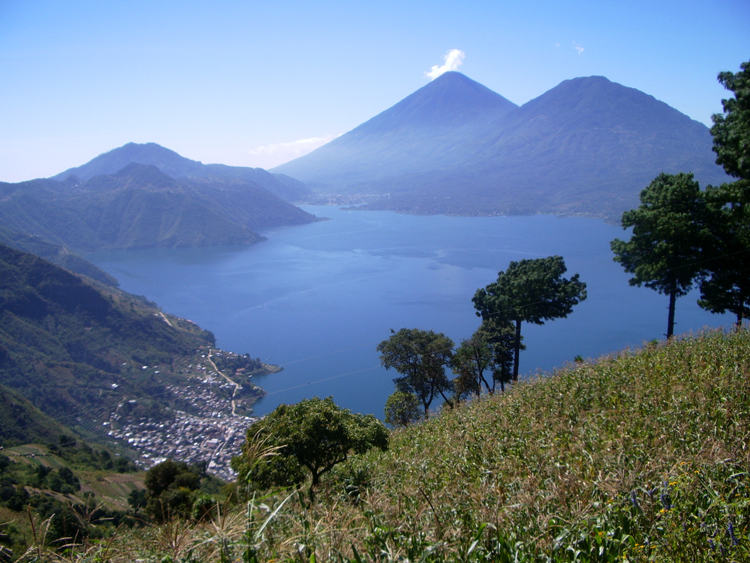

Panajachel, or Pana, is a small town of just over 10,000 people located to the west of Guatemala City. The town sits on the shores of Lago Atitlán, a huge lake sitting in an imminent caldera surrounded by volcanoes. The lake is supposed to be one of the most beautiful places in Guatemala, if not Central America and is very much a tourist destination. The people of the region are mostly of Mayan lineage. The area supports crops such as corn and coffee bean growth.


Current Events in Guatemala


Just over a week ago a prominent lawyer named Rodrigo Rosenberg was assassinated while riding his bicycle in Guatemala City. A video surfaced a week later of the lawyer warning that if the video was ever found it meant that his assassination occurred through direct involvement by the president, álvaro Colom. Rosenberg represented two Guatemalans who had also been assassinated and Rosenberg maintained that their assassination was directly the cause of corruption within the bank Banrural. In the aftermath of the assassination of Rosenberg, the middle and upper classes of Guatemala have called for the resignation of the president and more recently signed a 35,000 signature strong petition asking the congress to make Colom eligible for prosecution.


Colom has stated that the video is a fake and has even allowed for the intervention of a UN security task force on corruption as well as an in investigative branch of the FBI to investigate his involvement in the murder. There have been peaceful demonstrations in the capital calling for the resignation of the democratically elected president.


As of now, it seems that everything is still decently safe in the country, but I'll be watching the current events pretty closely and making a final decision of whether to go or not based upon how stable things are the day before my departure date, May 25th. The directors of Whole Planet Foundation and Grameen Bank have all been keeping close tabs on the current events and will advise if necessary.

Anyhow, that's a little about what I'll be doing during my time in Guatemala. I'm not entirely sure how available internet will be during my trip, if at all, so I can't guarantee a high frequency of updates, but I'm going to try to update as often as possible. I'm very excited about this opportunity to experience this first hand and I hope that everything goes smoothly. If you want more information, check the links on the side bar to the right, the video introduction invludes a small interview of Alomgir Hossein, the man who leads the Grameen Microcredit in Panajachel. As always, feedback is appreciated =)

-Spenser

Friday, August 15, 2008

A final note

As of today, I've officially been back in the US for two weeks though one week was spent on vacation in Washington. It's pretty weird to be back and as much as some things have change, much is still the same. Taking my first few steps into the airport after the 12 hour plane ride made me realize how much I had missed things and how remarkably good I had become at placing those things I missed at the back of my mind. I realize 6 months is not that long, but in some respects it's still a pretty long time. It's incredibly refreshing to be back amongst family and friends and in a place I know so well that I don't have to think and rethink every move I make in terms of leaving the house or trying to navigate a bus system or crowded subway in rush hour. I'm more than happy to eat the fatty foods I had forgotten and the spiciness I had missed so much. It's also kind of nice to drive a car again.

Anyhow, I've been meaning to make this final update to this blog for a couple weeks (honestly even before I left Argentina), but haven't gotten around to it. I've been debating this the entire time but I made an entry in my personal journal right before I started traveling in July that I think I'm going to transcribe here, though not word-for-word. It's a little bit over the top but I tend to get that way when I'm up late and have nothing better to do than just collect my thoughts. Here it is:

"I'm about to sleep in this bed for the last time and ironically enough I can't sleep. This reminds me a little bit of the way I was back on the night of February 18th, the first night I spent in this room. I was scared out of my mind and sleeping was the last thing on my mind. What the hell had I gotten myself into? I remember my first impressions of the apartment so well: the smells, the suffocating heat and humidity that aided my initial sleeplessness, the unfamiliar hum and roar of the busses and cars constantly passing the apartment thirteen stories below and the subtle annoyances of big city living that were so incredibly foreign to me.

Now I sit here staring into the darkness. How is this over? As cliché as this is, it feels like it was yesterday that I stumbled into Argentina. It saddens me to see the empty room and the dark shadows of my packed bags in the corner. I'll miss the small things I've become so accustomed to during my time here: a welcoming "Buen día" from the porter, the call to cenar (eat dinner) from our maid Rafaela, conversations with my host mother Greta, coffee and toast with dulce de leche every morning, alfajores, colectivos, subtes, taxis, Malbec, cheap beer, coming home on a colectivo from the bar or boliche at 6 in the morning (because that's normal), constantly speaking Spanish and always having to pre-think what I'm going to say and how I'm going to go about doing so, the parks, avoiding little land mines in the form of dog crap on the street and the Porteño attitude.

As much as I disrespect the elitist European-like-attitude that many Porteños like to fulfill, I'll miss them. I won't miss their blatant racism towards dark skinned people, but I've come to love their culture. The kiss-on-the-cheek greetings, mate culture, Tango, Gauchos, the silly accent…

I think back on the times when I was pretty homesick and realize how I've grown. What a fantastic experience this has been. I've met incredible people, seen absolutely beautiful places and learned that I can settle and thrive anywhere I might be. I will admit that I cheated myself on more than a few experiences; always resorting to watching the channels that played American shows (though they were better than their Spanish alternatives…), being shy around Argentines in class, etc. This experience has taught me how beautiful the world really is and how much of an urge I have to travel it. I've seen how badly some people have it as well and know that someday this experience will bring me back here, though God only knows for what reasons…

Studying here was the best decision I have ever made for myself and through thick and thin I have absolutely nothing to regret. I've learned so much and I'll even go as far as to say I'm fairly proficient in a foreign language now. I've been incredibly lucky and blessed to have had the opportunity to do this and I'm extremely thankful for having such great parents who supported me in this endeavor. Studying abroad has been a dream of mine as long as I can remember and it's almost anticlimactic that it's over; it's a little scary to think that the next big event in my life is going to be graduation."

The next day we took off on our 2000 mile journey through South America, another indescribably amazing experience. I can't even begin to explain how lucky I have been in the last 6 months. I wouldn't trade this experience for anything in the world and this is something that I will remember and reminisce about for the rest of my life.

On another note, thank you so much for reading if you've kept up with this. I've tried to make most of it at least mildly entertaining but I still realize it's hard to remember to check back to someone's blog who is living on the other side of the world when you've got your own things to worry about. It means a lot of me that people were interested enough in what was going on with me to read this and I really, really appreciate it.

I got a little bit lazy with the blog towards the end of the trip, but if you want to know more about the end of it just let me know and I'll tell you. Thanks again, and if I haven't seen you yet, hopefully I'll see you soon.

Chau!!!

Thursday, July 24, 2008

Pictures from Cusco

Here are three albums I just loaded onto Facebook from the last few weeks

More Colca and Lake Titicaca

Cusco and around Cusco

Machu Picchu

Chau!

Monday, July 21, 2008

Cusco

update:

Here's the link to the one album i was able to load. Its all of Arequipa, Colca and a little bit of the trip to Puno. For some reason the pics are a little mixed up, but there they are. I'll try to load more in a day or two. Machu Picchu at 5 AM.

Arequipa, Colca, Puno Perú


We finally made it to Cusco, I'm just going to make a brief update on whats going on and I still cannot load pictures..whatever though.

We did the homestay on the island in Lake Titicaca two nights ago. It was really interesting and I'm really glad we did it, they fed us traditional food which mostly consisted of 4 or 5 different varieties of food and we had a fiesta on the island and they dressed us up in their traditional clothing.

We're in Cusco now and did a tour of the sacred valley yesterday. We saw our first true Incan ruins and they were amazing. The holy grail is tomorrow though when we depart for Machu Picchu at 6 AM. We're doing a city tour this afternoon and have spent some time in museums this morning. Cusco is a really pretty city with lots of very narrow cobblestone streets set alongside the hills.

I haven't decided what comes after Machu Picchu and it's scary that this journey is over in 5 days! There's lots to do here though so I don't think I'll be at any loss for entertainment.

I'll try to post pics from the hostel tongiht, its going to be like 200 pictures though probably so no guarantees. Hope all is well!

Thursday, July 17, 2008

Perú

I got a bit bored on the bus and wrote a long entry. It's a bit dry as in "we did this and then we did that", but here's pretty much what we've been up to the last few days for those interested...

Perú, Perú, Perú. We traveled the day after I last updated from San Pedro, Chile to Arequipa, Perú; a ride consisting of only about 15 hours of bus travel but for some reason we were unable to find a direct bus from Calama (the largest city to San Pedro) to Arequipa. We rode the 8 hours overnight from Calama to the border town of Arica, Chile. To get from Arica to Tacna, Peru you have to take a collective taxi from the bus station in Arica to Tacna. A guy followed us around when we got to the bus station until he was able to rope us into his office where he sold us the taci and the connecting bus ticket from Tacna to Arequipa for about 24 US. He sat us in his little 90's model Chevy car and told us to wait while he went to find more people to fill the taxi. The parking lot was pretty sketch and it wasn't exactly a comfortable spot to be alone. I must say we weren't exactly sure what we had gotten ourselves into in the beginning though we had read that what we had done was pretty much the standard. We were relieved when a younger Chilean couple cam and got in the car with us. The 2 hour journey went off without any hitches, fortunately, and he dropped us off at the bus station in Tacna with our bus tickets. For some reason we decided not to exchange any of our money in Chile and when we arrived in Tacna there was no power so we couldn't use an ATM and it was a Sunday so we couldn't go to a Cambio leaving us broke by Peruvian currency standards. I had to use the bathroom pretty badly and there was a lady sitting outside charging for its use. I watched her and ran past and used the toilet and then tried to leave but she forced me to stop. I ended up having to concede my sole remaining granola bar as a form of payment. Barter systems suit me anyhow.

The taxi guy charged us a little more than what he paid for the tickets and we ended up getting on an economico bus, meaning it was the cheapest one we could take. We had front row seats both on the bus and for our introduction to Peru. At every small town we stopped at 7 or 8 people would run on the bus shouting and selling everything from avocados to sodas to fried chicken (the chicken venders made sure to point out that their chicken was cold). When the bus started going again it was a mad dash to the front to bang on the door seperating the driver and the passengers in order to try to get off the bus. A few times they just rode to the next town.
After a few chuckles and wondering where the hell we were we finally made it to Arequipa and fond our way to our hostel. We sat around the hostel the rest of the day to rest up and drank coca tea, a very welcome respite. Although we were a little afraid of where we had placed ourselves on the journey we still remained wary of what was going on and were in control (for the most part) of what was happening to us, so mom and dad don't worry. haha.

Our first ful day in Arequipa we walked around for a bit and found the Santa Catalina Monastary. The monastary was built in the 16th century by a wealthy Spanish woman for nuns of rich families. The nuns, once having entered, were never allowed to exit and had to follow strict rules such as only cutting and washing their hair 7 times a year. There were once hundreds living within the walls but now the number has dwindled to about 30. The monastary resembles a small city with is narrow streets and housing complexes and tons of rooms. The monastary's walls were painted in bright blue and red hues following its opening to the public in the 1970's. We spent about an hour and a half in the place finding every room we could possibly find and just doing some straight up exploring; pretty fantastic place.

After the monastary we checked out of our hostel and went to a small hotel that Marc (the guy I've been doing my internship with at CAT Travel) helped work out for us. We then met our guide who gave us a half day city tour including...a trip to the monastary. We were a bit disappointed but we learned a lot more having an informed guide lead us around. Our tour then continued to the main plaza where the cathedral is located. The cathedral has been destroyed several times by earthquakes and then rebuilt. Its not all that impressive but they did have an interesting carving of the devil underneath a pulpit. Odd. We then continued to another smaller church which has 4 huge elaborate golden altars and memorials of Saints. In the back of the cathedral there was an ornately painted domed room. The room is a kaleidascope of different colors and veyr beautiful drawings done by the indians of the area, unfortuntaly we were unable to take pictures and it was pretty breathtaking.

That night, based upon recommendations from our guide, we went to a restaurant that is supposed to serve the best cuy in Arequipa, a very traditional dish of the area. We ordered ourselves some cuy chactado and a beer with a German girl we had randomly ran into that we met in Chile. Cuy would generally be considered a pet in the US but in Peru, as the natives will tell you, ¨Cuy es muyyy rico¨or Guinea pig is very delicious! Haha. Guinea pig. Cuy chactado is the guinea pig whole including the head and the legs. When we ordered our waiter told us that we were very brave and then asked us if we had seen the movie Predator. Not a good sign. The cuy came out whole with its jaws broken apart and its teeth still intact, and supposedly looked like the aliens from Predator. It wasn't the best thing I've ever had, the texture and taste were very similar to chicken only it was much harder to eat. Anyhow, I tried it and now I can add that to my list of odd things I've been adventerous enough to try. The food in Peru is much better than Argentina though, mainly because its spicy.

After our big day we took a tour to Colca Canyon. Colca is the second deepest canyon in the world and is situated in the Peruvian Cordillera. We stayed in a very nice hotel outside of Chivay, Peru called El Refugio. The hotel sits along the Colca river in its own little ravine and was an extremely nice place to take in the beauty of the area and relax. The hotels guide took us that night to the local hotsprings and we sat around for a while and sipped on the national drink of Peru, Pisco Sours (though the Chileans would argue that Pisco Sours are their creation).

The next day we had free to ourselves. In the morning the hotels guide took us to some ruins near the hotel and explained that it had once been a thriving city until the arrival of the Spanish who forced the people out of their homes and burned the city so that they could never return. Some of the tall natural brick houses still stand silouetted against the mountains. The guide explained a lot of the history and pointed out the pre-Incan terraces that were built into the sides of the mountain.

After the tour we walked into Chivay, which was about a 30 minute walk from our hotel. We hung around in town for a bit and had some more Coca tea and bought some souvenirs. The coca leaf is very popular here and people chew it to battle altitude sickness. The tea is pretty tasty and they also make candy and baked goods out of it. The leaves are of course from the same plant as cocaine and are illegal back home. Whatever.

We spent the evening in our hotel reading and writing and preparing for the early tour the next day which began at 630 AM. We met our guide that morning (that morning techinically being this morning) and took the 2 hour drive out to the Cruz del Condor where one can see a huge group of condors flying around. They come out about 830 every morning and disappear about as fast as they appeared to hunt in the mountains. They return everyday mid afternoon. It was pretty cool to see the graceful birds soar effortlessly through the canyon. We then hiked a little bit away from the veiwpoint and saw the deepest par of the canyon which is over 1300 meters deep at its most extreme. We ate some cactus fruit at a nearby stand that tasted a lot like kiwi and then continued on and met another bus to head to Puno which sits on the shores of the great Lake Titicaca which is the highest navigable lake in the world. Titicaca means grey puma in the native language and it is considered a navigable lake because it can host the sailing of huge ships meant to transport goods between the different shores. On the way we saw a pretty cool rock formation and were able to walk through it as well as a bunch of flamingos.

We're in Puno now and we're going tomorrow morning on a 2 day tour of Lake Titicaca which includes a homestay with a family on one of the lake's islands. Should be really interesting.

The computer I'm on is crappy so I can't load photos to facebook but hopefully that'll come soon. Thanks for reading all of that if you actually stuck around... Miss y'all!

Saturday, July 12, 2008

Walking on the moon

So yesterday after I updated we took a walking tour through the driest desert in the world. It looks like the surface of the moon and is absolutely beautiful. We did the tour through a small company called Cactus tours and ended up with a group of four; Emily and I and a couple from Dallas. I ended up finding out that the guy went to Tech and graduated a couple years ago. It was pretty weird considering we're in northern Chile in a tiny tiny town. We hiked through a ravine and then took a bus to catch the sunset over the Valle de la Luna, or Moon Valley.

Through talking to the couple from Texas we found out about a stargazing tour that night. We got back to San Pedro and booked the tour and headed out to the small observatory outside the city. The desert here is so dry that clouds very rarely form and the conditions are near perfect for star watching. The man who owns the telescopes is French and speaks Spanish, English and of course, French. Our tour ended up being in Spanish and was very very enjoyable. He told us all about the stars and pointed out tons of different constellations and planets. We then got to look through the different telescopes at Jupiter, Mars, Saturn, a star cluster, a nebula and a high resolution shot of the moon. They even let us take pictures of the moon. Here's the one I got on my camera

After the tour they gave us hot chocolate and told us a little bit more about the stars. We then went to dinner with the Texans and got to bed early as we were leaving for a tour of the geysers at 4 AM.

4 AM in San Pedro de Atacama in the dead of winter is not a fun time. When we woke up it was probably about -9 degrees celsius. We got on our tour bus and headed out to the geysers just before dawn, where the temperature still read -9 celsius. It was FREEZING, but totally worth it. The geysers are the highest in the world. In the world, our guide told us, there are just over 1000 geysers, half of them located in Yellowstone. The field here is home to 40 of those 1000. I know I keep using the words ¨incredible¨and ¨beautiful¨but thats just how it was. The tour then took us to the thermal pools which were anywhere between 25 to 40 degrees celsius. We almost didn't get in because it was still bitter cold, but decided it was the only time we might get to do something like this and took full advantage of it. Although it sucked getting out, we were much warmer once we got our clothes on than we were before we got in the water. The tour then took us through the valleys to a small village where we sampled llama meat. It was pretty tasty, I must say. We say a wide array of flora and fauna in the area and overall it was a great but tiring tour.

Tonight we get on a bus to head to Arica in the far north of Chile to cross into Peru. This will probably be the longest and hardest leg of our trip but we should be in Arequipa by tomorrow night. We'll sleep on the overnight bus tonight, hopefully, though the bus won't be the lap of luxury we've come to know in Argentina. Here's the same link to the San Pedro de Atacama Album I've put up on facebook but I've loaded a lot more pictures from the tours in the last two days:

San Pedro de Atacama

Hope everyone is well, miss y'all!

Friday, July 11, 2008

Chilly Chile

We're now in San Pedro de Atacama, Chile. We've spent quite a bit of time on busses the last three days... the 20 hr one from Buenos Aires to Salta, a 15 hour bus tour around Salta the next day and then a 10 hour bus trip from Salta to San Pedro de Atacama, Chile.

Salta was pretty incredible. We took a tour of the surrounding areas and went to the Salinas, or Salt Flats, which were pretty incredible and huge. The bus tour took us around a pretty big circuit that included stops along the way in a couple small villages as well as Purmamarca, which is famous for its 7 colored hill. Unfortunately the lighting was not right for views of the hill, but the surrounding countryside was an array of greens, maroons, reds, and browns. It was beautiful. We also went to the salt flats in the area which were formed as the sea dried up in the area. The area is pretty far from the ocean now but at one time the land was deep beneath the water. There are a ton of man made pools in the area that they put water in and then extract the salt out of once the water evaporates.

Thursday we got up early and got on the bus to Chile. Where we're at now is extremely dry and is pretty warm during the day but gts VERY cold at night. The temperature can range from anywhere between -20 celsius at night to 20 celsius during the day. None of the buildings have heating and you have to bundle up pretty well if you want to even think about sleeping. The village is gorgeous though, its all adobe and dirt streets and very laid back. The people are very friendly and its a really nice place to take a stroll. Today we´re going on a tour out to watch the sunset on the Valle de la Luna. The surrounding desert is one of the driest in the world and is supposed to resemble the moon in its landscape. Aside from the small town that we're in, its petty barren, just a lot of rocks and steep mountains in the surroundings. Tomorrow we're taking another tour in the morning to watch the sunrise over the geysers...pretty exciting...

Thats all I've got for now, but here are the links to the pictures I took in Salta and the couple that I've taken so far in Chile, more to come on those.

Salta, Argentina

San Pedro de Atacama, Chile